Skip to content
ISEAGE Cyber Defense Challenges

Recent News

Fall ISU CDC 2013 Shell Server Git Repository and Flag

There was an error when setting up the git repository on the shell server.  It is empty.  We need to put the correct code there as well as commit and push the flag that belongs in the repository.

Follow these instructions.  Note the first block must happen on the shell server, the second block can happen on any machine that can access the shell server (including your laptop if it is running a flavor linux/unix and has git):

# ON THE SHELL SERVER, DO THIS:
export HTTPS_PROXY="http://199.100.16.100:3128"
git clone https://github.com/benjholla/Blackbook.git
cd Blackbook
cp -r .git/ /home/git/webapp.git
cd /home/git/webapp.git
git update-server-info
git --git-dir=/home/git/webapp.git config core.bare true

Note: “path/to/flag_file.flag” is a placeholder for wherever your flag file is currently on the file system.

# ON ANY CLIENT MACHINE THAT CAN ACCESS THE SHELL SERVER
git clone git@shell.teamN.isucdc.com:/home/git/webapp.git
cd webapp
mv /path/to/flag_file.flag .
git add flag_file.flag
git commit -m "Adding flag"
git push origin

Note: The author of the shell box would like to point out that this was not his mistake.
Connecting to the ISEAGE VPN

ISEAGE now supplies a VPN to connect your machine directly into the management range.  This will allow your machine to access everything on the competition range.

Viscosity is a fantastic VPN client for all platforms, however it is not free.  If you would like to use Viscosity, you can import this connection file. It should work out of the box with that connection file.

OpenVPN Connect is another decent VPN client.  Simply install the client, download this connection configuration file, and double click it to open it with the OpenVPN client.  You will also need the CA certificate file linked below. Extract it into the same directory as the configuration file.

If you don’t want to use either of those clients, you can use another openVPN client of your choice.  Here are the configuration options you will need:

CA certificate file: download here.

route-gateway dhcp
remote vpn.iseage.org 1194 udp
persist-key
auth-user-pass
tls-client
pull
ca iseage-ca.crt
redirect-gateway def1
dev tun
persist-tun
nobind
dhcp-option DNS 199.100.16.100

After configuring your client, connect to the VPN. It will prompt you for a username and password. Use the same credentials as you use to connect to IScorE/RDP/vCenter. Do not include the “ISEAGE\” part before your username.

LDAP Check Fixed

Hello participants – a quick note!

The LDAP check was broken because it was still using the old domain scheme for its queries (siteN.cdc.com instead of teamN.isucdc.com).  The problem has been fixed and now some Active Directory servers are scanning as up!

Tutorial: Connect to Support Chat with Adium for Mac OS X

Here is a quick guide for connecting to the support chat server with Adium, a multi-chat client for Mac OS X.

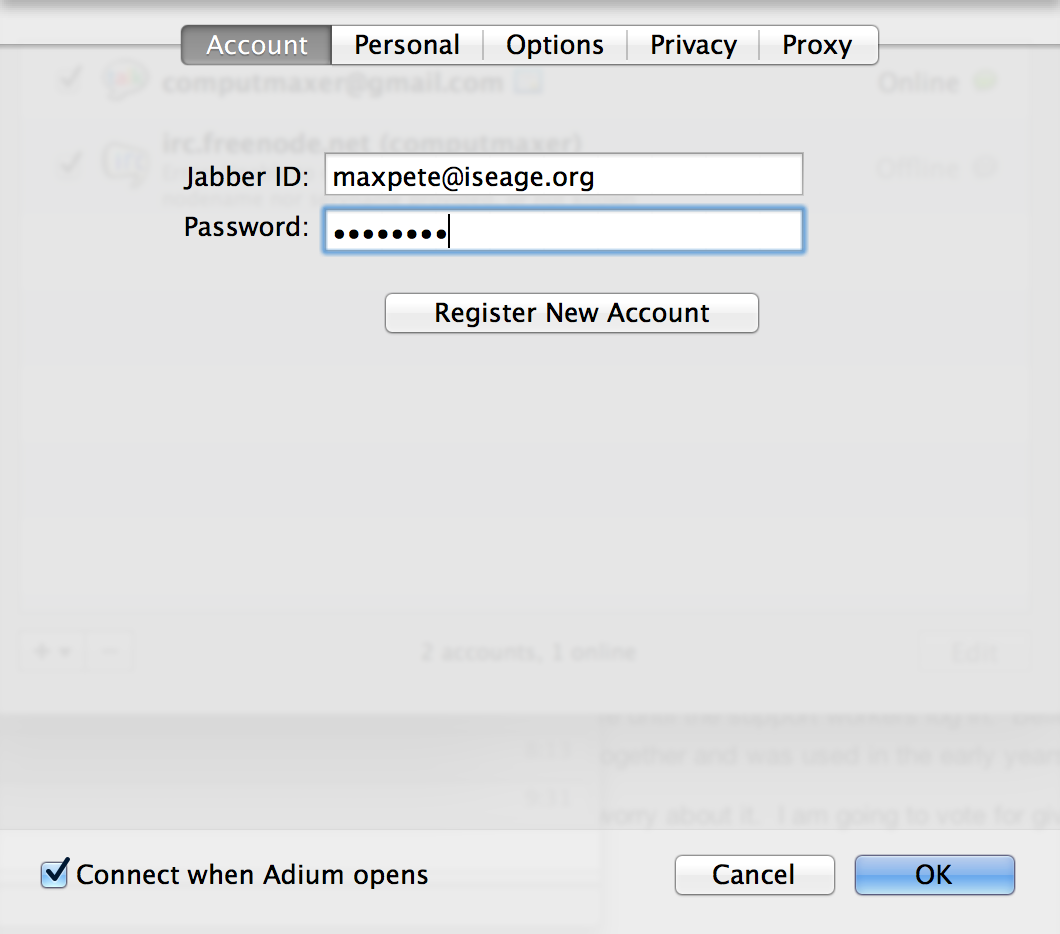
First, launch Adium and go to Preferences –> Accounts.  Click the ‘+’ to add an account.  Choose ‘XMPP’ for account type.

adium1

Enter your account name.  This will be <your_username>@iseage.org:

adium2

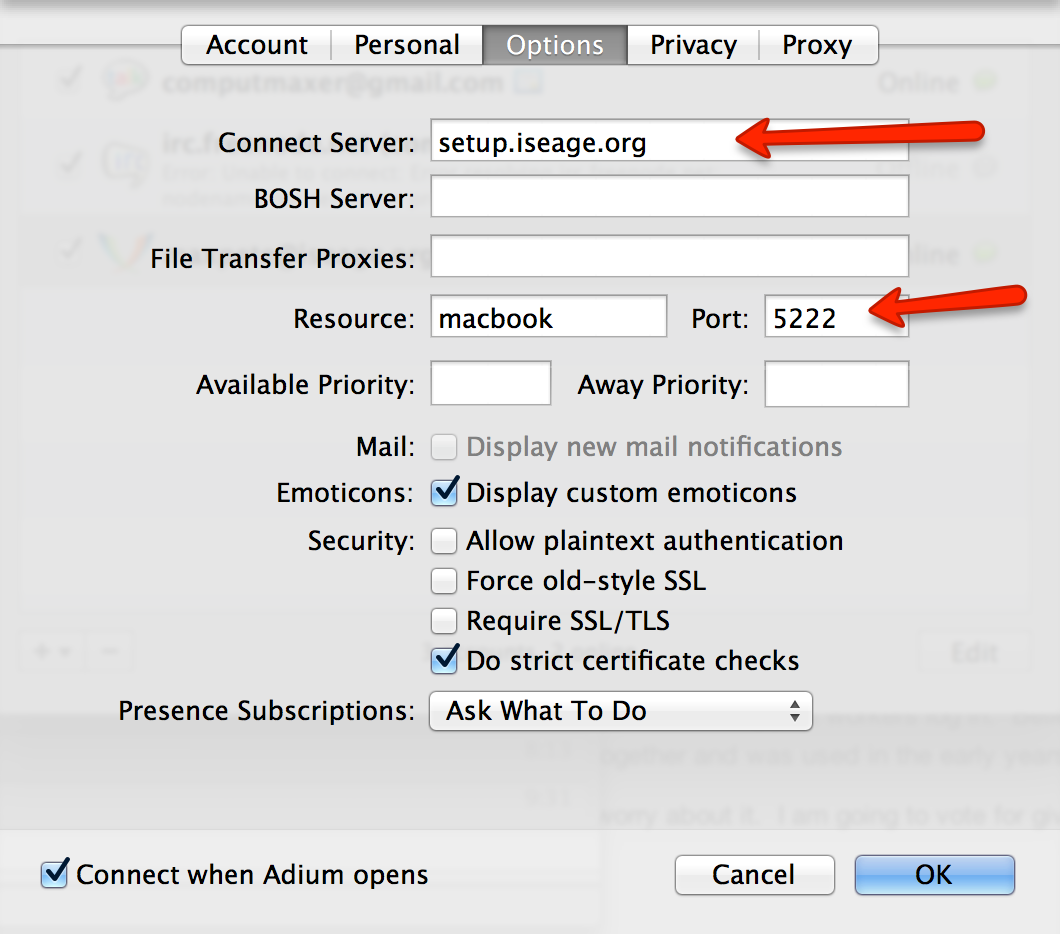
Next click the ‘Options’ tab and enter the server and port as seen below.  Server should be “setup.iseage.org” and port should be 5222:

adium3

You may now click ‘OK’ to add the new account.

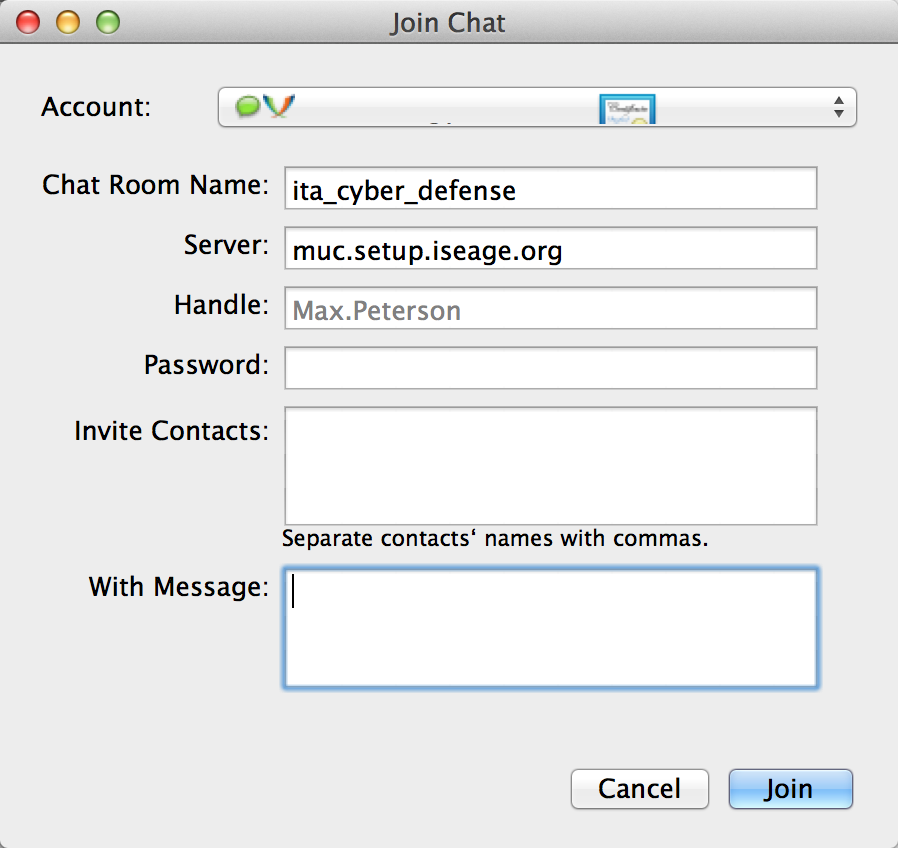
Now you are ready to join a chatroom.  Go to File –> Join Group Chat… Choose the account you just created from the account dropdown list if it isn’t already selected.
Type in the chatroom name such as ‘supportchat’ or ‘ita_cyber_defense’.  The server must be set to “muc.setup.iseage.org”.  Handle will be your nickname upon joining.

adium4

Repeat the last step for every chat room you want to join.

Congratulations! You’re finished!

Tutorial: Connect to Support Chat with Mac OS X Messages

Here is a quick guide for connecting to the support chat server with Mac OS X Messages application.

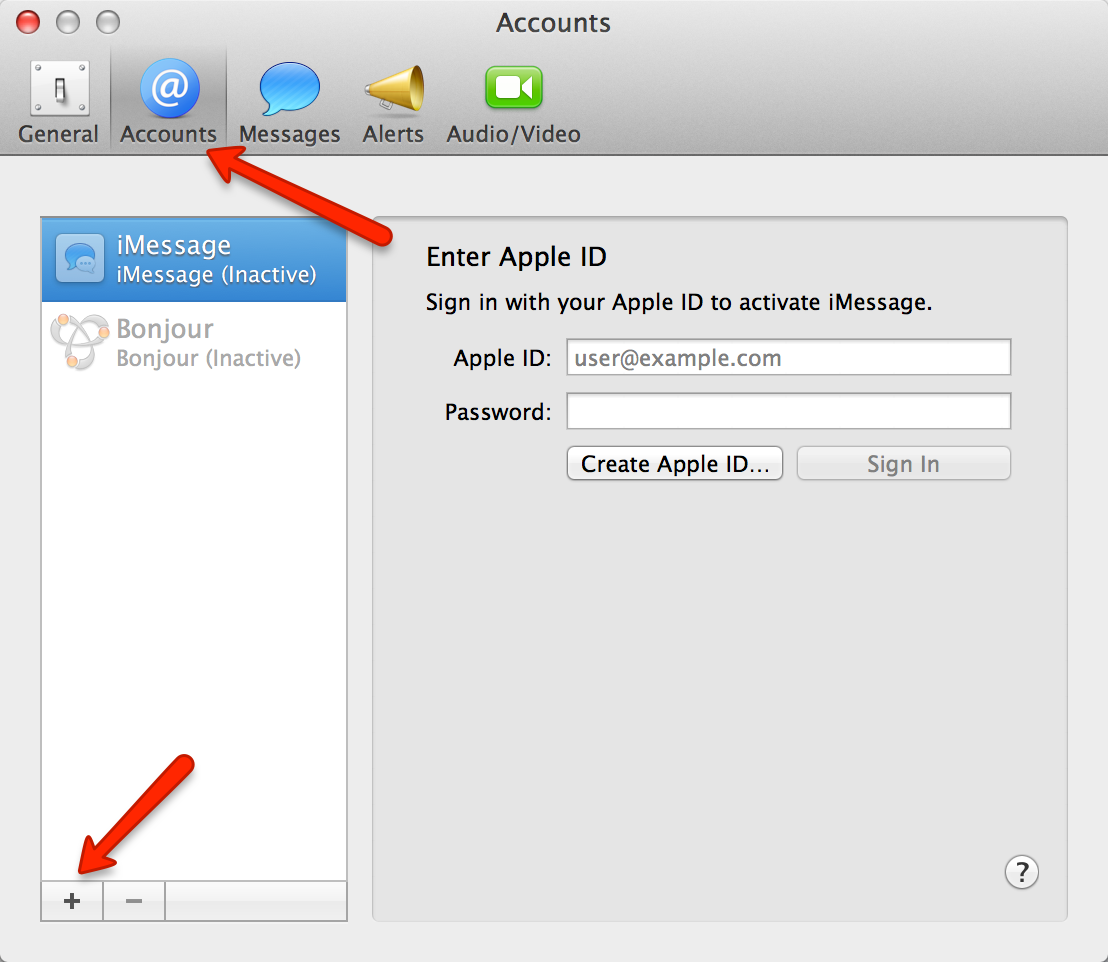
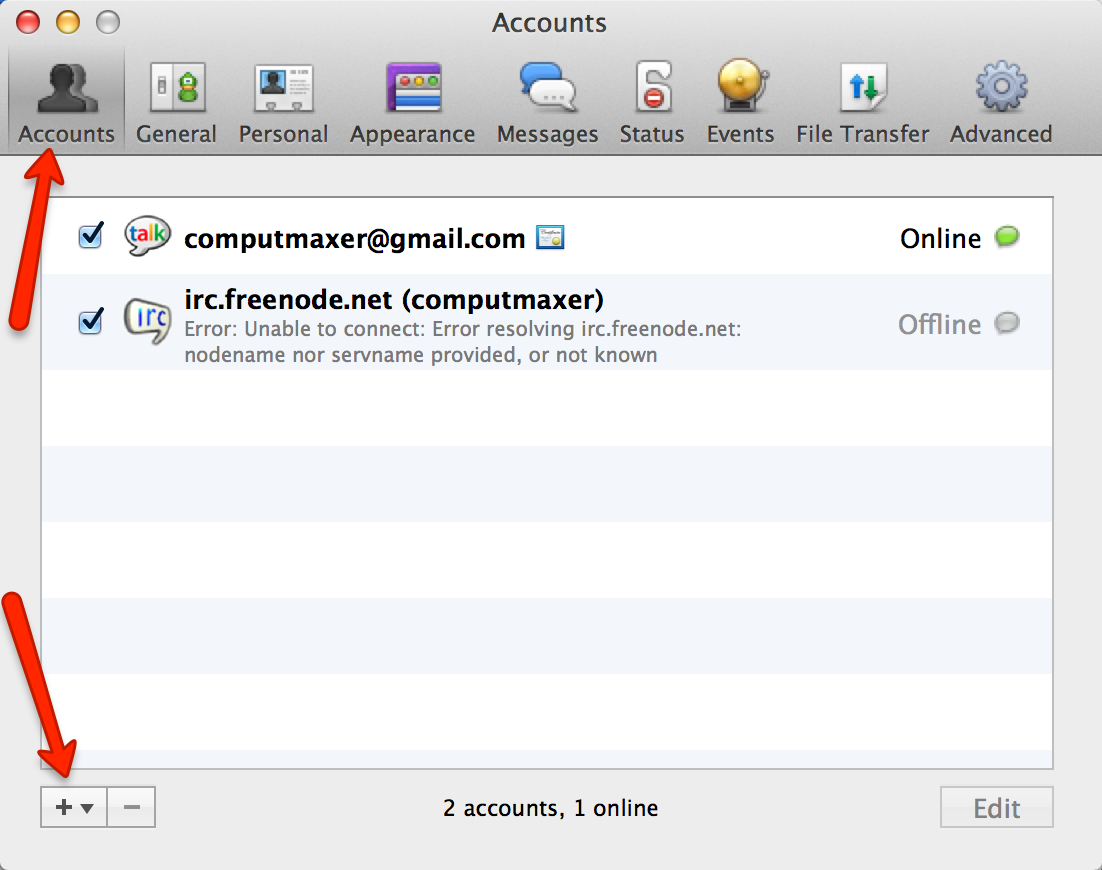
First, launch messages and go to Preferences –> Accounts.  Click the ‘+’ to add an account.

messages1


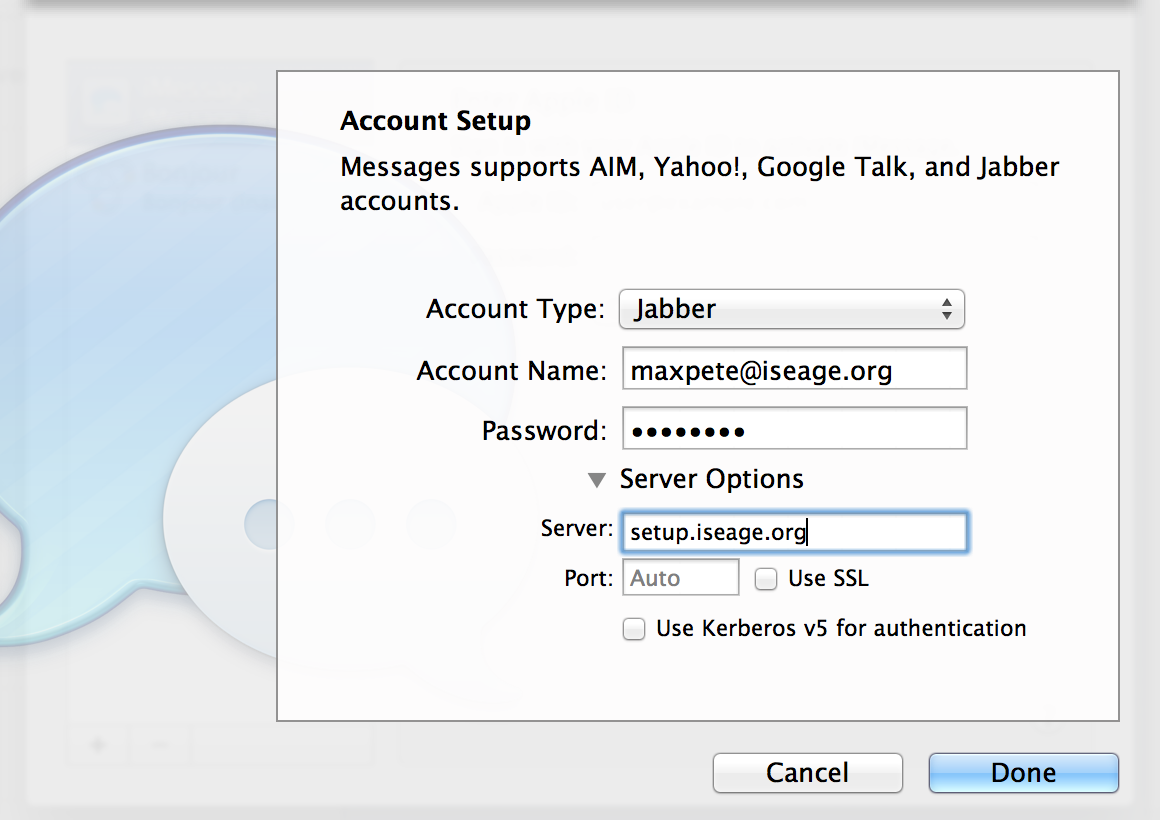
The account name should be <your_username>@iseage.org as shown in the following screenshot.  The server should be “setup.iseage.org”:

messages2


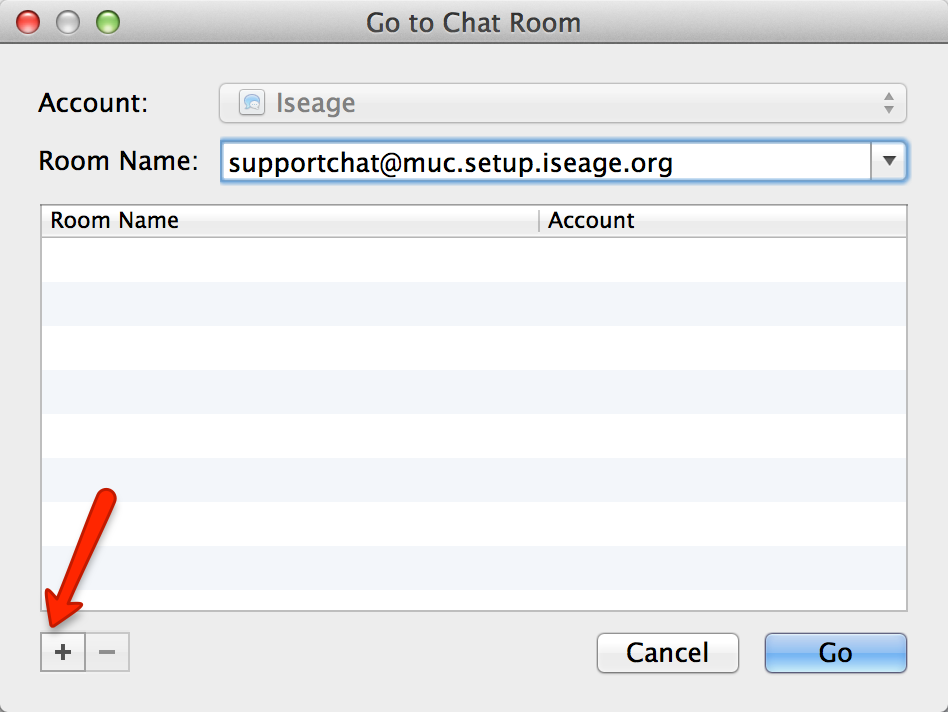
Next, do File –> Go To Chatroom… or use the keyboard shortcut COMMAND-R to join a chatroom.  The room name will be “<name_of_chatroom>@muc.setup.iseage.org”:

messages3

Repeat the last step for every chat room you want to join.

Congratulations! You’re finished!